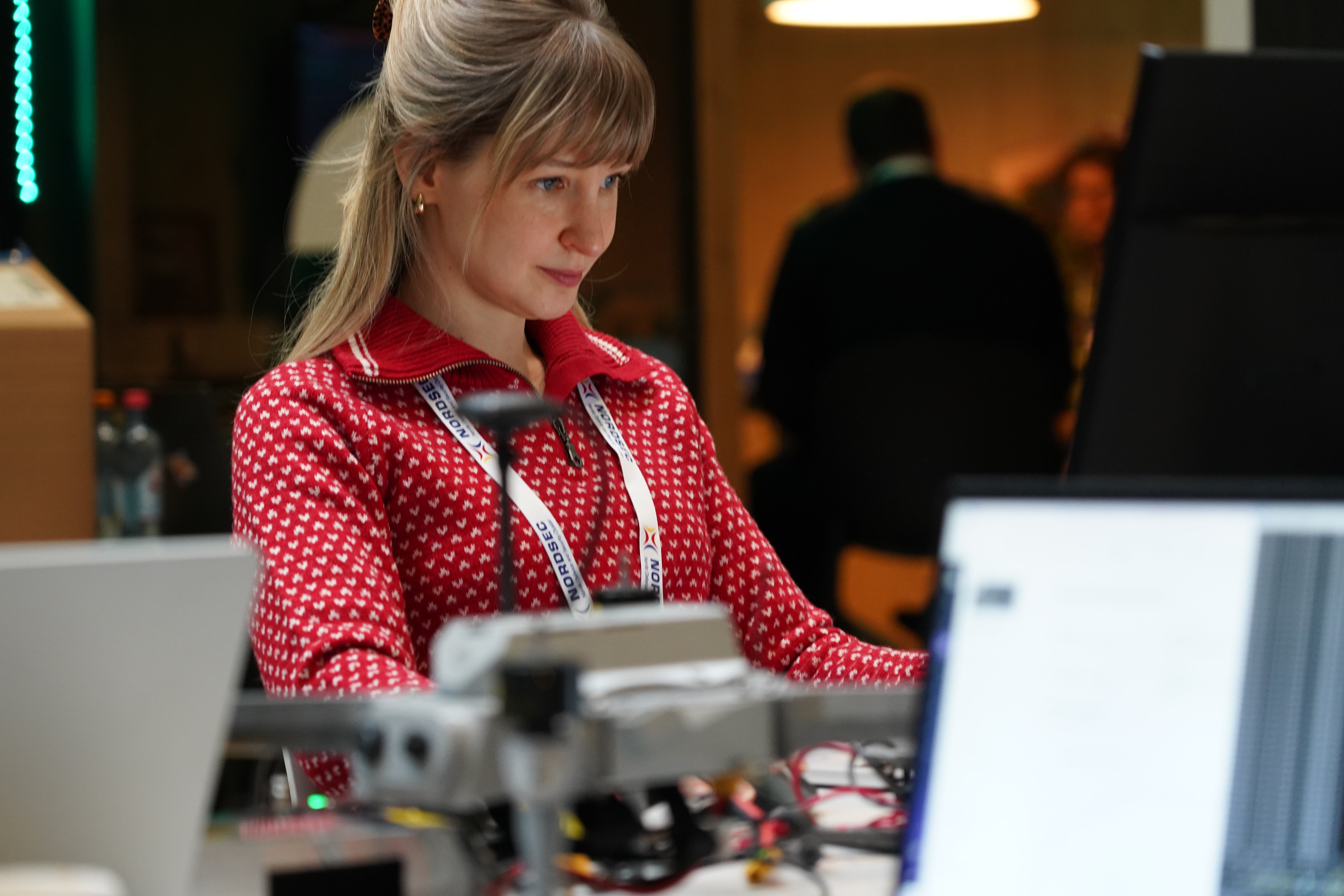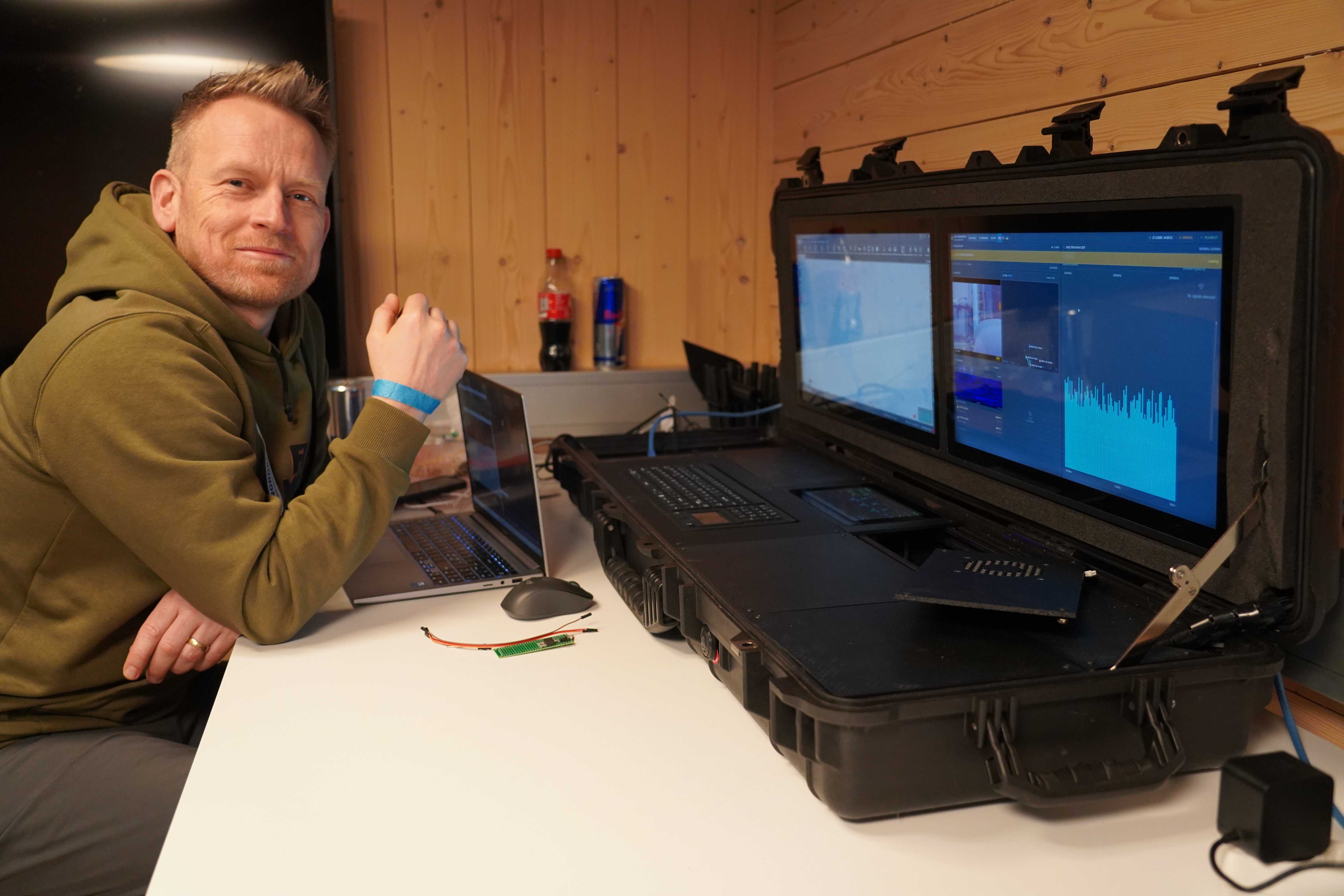

The NORDSEC EUDIS Defence Hackathon 2026 marked a major milestone for defence innovation in Norway, bringing together startups, industry professionals, students, and defence stakeholders for three intensive days of problem-solving under the theme Defending Airspace. The event, hosted in Trondheim, is part of the European Defence Innovation Scheme and was held simultaneously across eight countries, addressing some of Europe’s most pressing security challenges.
At the Norwegian edition, teams tackled real-world challenges ranging from cost-effective drone interception to next-generation detection systems. The outcome: concrete, scalable solutions with clear operational relevance—and three standout teams on the podium.
.jpg?width=960&height=640&name=NORDSEC%20EUDIS%20Defence%20Hackathon%20-%20Photo%20Lars%20Bugge%20Aarset%20Fremtidens%20Industri%20(62).jpg)
The winning team: Tiepoint from Andøya. Photo: Lars Bugge Aarset/Fremtidens Industri
Tiepoint takes first place with AI-powered interception
A Tiepoint team claimed first prize (EUR 6,000) with an AI-driven drone interception concept designed to address a rapidly growing capability gap.
Their premise is straightforward: while drone warfare is scaling quickly, interception systems remain expensive, difficult to scale, and dependent on highly trained operators. Current success rates often hover around 20–30 %.
Tiepoint’s solution shifts the paradigm. Instead of manual piloting, the operator identifies the target while onboard AI takes control, calculating and executing the optimal interception path in real time. The system is trained using reinforcement learning and large-scale simulations, continuously improving across thousands of scenarios.
The projected impact is substantial: success rates approaching 90 %, combined with reduced cost per interception and less reliance on elite operators.
Importantly, the team moved beyond theory during the hackathon. They developed detection pipelines, improved simulation fidelity, and demonstrated interception rates nearing 70 % in controlled environments.
With a combination of operational drone experience and deep expertise in AI and control systems, Tiepoint is now looking toward real-world deployment in collaboration with defence stakeholders.
As the national winner, Tiepoint now advances to a two-month EUDIS mentorship programme, where they will further develop their solution and compete against the seven other national winners from Spain, Portugal, Czech Republic, France, Poland, Romania and Netherlands.
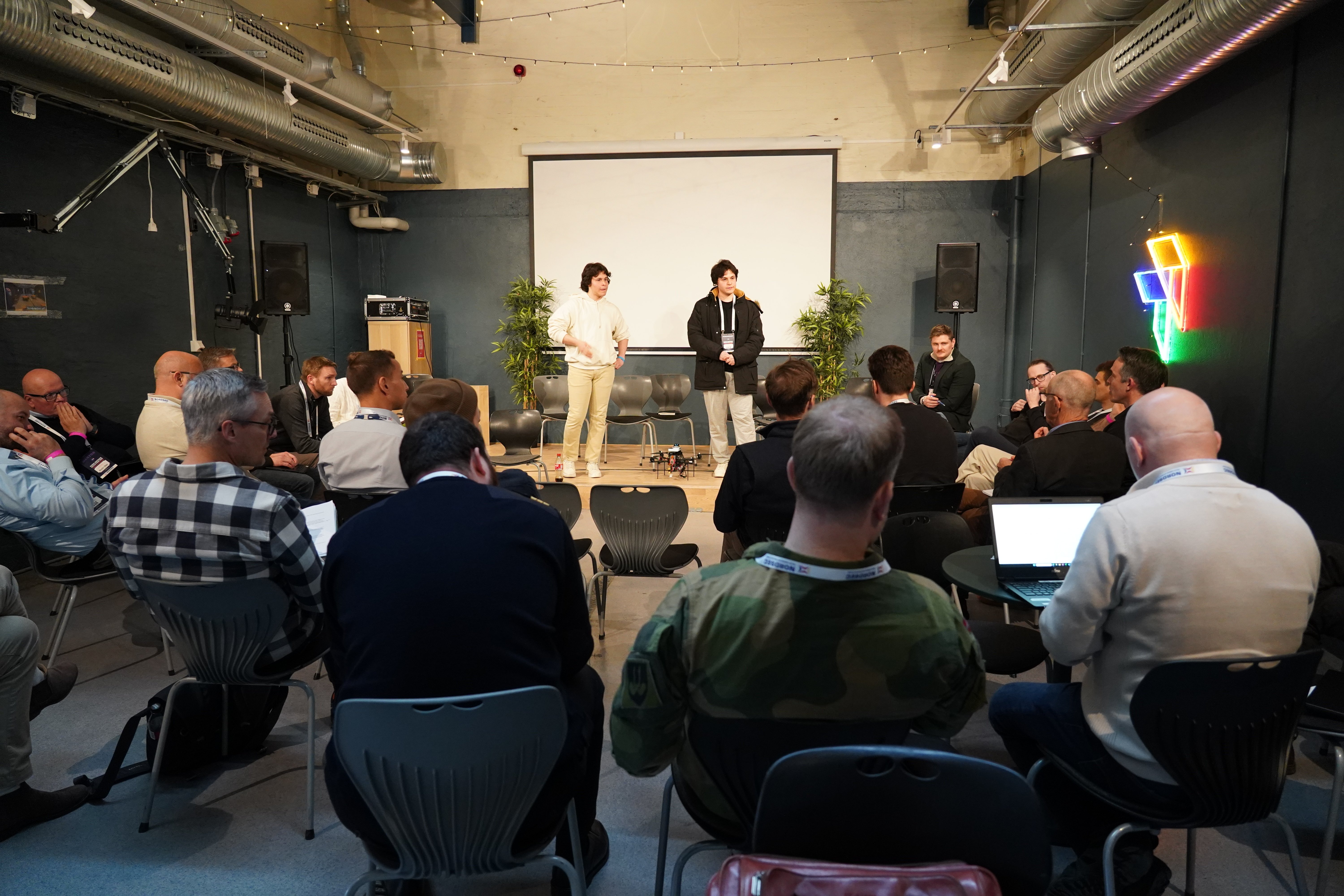
Photo: Lars Bugge Aarset/Fremtidens Industri
Halodyne secures second place with autonomous counter-UAS platform
Second place (EUR 3,000) went to Halodyne with its autonomous close-range counter-UAS platform, HALO-1.
The team addresses a fundamental gap on today’s battlefield: drone detection is still largely dependent on the human soldier—an approach that is neither scalable, survivable, nor integrated.
HALO-1 is designed as a fully autonomous, mobile counter-drone system that combines detection and effect in a single platform. It integrates multi-domain sensor capabilities and enables a continuous chain from detection to tracking and engagement.
Unlike fixed systems, HALO-1 operates without infrastructure and is built to move with the mission, supporting both defensive and offensive scenarios.
The architecture is autonomous by design, with a clear separation between safety control and operational software. This enables a human-on-the-loop model, reducing operator burden while maintaining oversight.
Halodyne has already demonstrated integration of advanced counter-UAS radar, underlining that the system is not just conceptual but positioned for field adaptation.
With deep expertise in autonomy, robotics, and defence applications, the team is now seeking collaboration with defence stakeholders to test, validate, and scale the solution in real-world environments.
.jpg?width=6000&height=4000&name=NORDSEC%20EUDIS%20Defence%20Hackathon%20-%20Photo%20LarsBugge%20Aarset%20Fremtidens%20Industri%20(126).jpg)
2. place: Halodyne. Photo: Lars Bugge Aarset/Fremtidens Industri
SPARK wins third prize with low-cost detection network
Third place (EUR 1,500) was awarded to SPARK for a fundamentally different but complementary capability: drone detection.
Where radar systems are costly and static, and RF-based detection has limitations, SPARK proposed a distributed, low-cost acoustic sensing network. Their system uses passive sensors to detect drones through sound, connected via a mesh network and designed for deployment without fixed infrastructure.
The concept is built for scalability. Each unit is battery-powered, mass-producible, and estimated to cost around $50.
During the hackathon, the team conducted more than 10,000 simulations and processed over 5,000 real-world audio samples. They also demonstrated how acoustic sensing can be combined with RF detection to improve overall situational awareness.
The solution directly addresses a key operational gap: limited awareness in environments where traditional systems are either unavailable or impractical.
.jpg?width=6000&height=4000&name=NORDSEC%20EUDIS%20Defence%20Hackathon%20-%20Photo%20Lars%20Bugge%20Aarset%20Fremtidens%20Industri%20(33).jpg)
3'rd place: SPARK from Norwegian Homeguard District 1. Photo: Lars Bugge Aarset/Fremtidens Industri
Strengthening Europe’s defence innovation ecosystem
The hackathon is part of a broader European effort to accelerate defence innovation and lower barriers for new actors entering the sector. Winning teams from each national event gain access to a follow-up mentoring programme and the opportunity to pitch at EU level.
Hosted by NORDSEC - Nordic Defence and Security Cluster in collaboration with partners including Norwegian University of Science and Technology, SINTEF and key defence actors, the event highlights Trondheim’s growing role as a hub for defence and security innovation.
Across all three winning teams, a common pattern emerged: solutions grounded in real operational needs, designed for scalability, and ready to move beyond prototype.
That is precisely the intent of EUDIS—turning ideas into deployable capability.
.jpg?width=6000&height=4000&name=NORDSEC%20Defence%20Hackathon%20Norway%202026%20Photo%20Lars%20Bugge%20Aarset%20Fremtidens%20Industri%20(19).jpg) Team Ascend NTNU. Photo: Lars Bugge Aarset/Fremtidens Industri
Team Ascend NTNU. Photo: Lars Bugge Aarset/Fremtidens Industri
NORDSEC well represented
Several NORDSEC members took part. In addition to the winning team Tiepoint, teams from MILUAS, at second place Halodyne, the drone group Ascend NTNU and the rocket group Propulse NTNU were also present with their own teams. Propulse NTNU is preparing for its next rocket launch this summer, and most of the teams will also be present at Forsvarskonferansen - NORDSEC Defence and Security Conference in September.
More pictures from NORDSEC EUDIS Defence Hackathon 2026
Photo: Lars Bugge Aarset/Fremtidens Industri
.jpg?width=6000&height=4000&name=NORDSEC%20Defence%20Hackathon%20Norway%202026%20Photo%20Lars%20Bugge%20Aarset%20Fremtidens%20Industri%20(29).jpg)
.jpg?width=6000&height=4000&name=NORDSEC%20Defence%20Hackathon%20Norway%202026%20Photo%20Lars%20Bugge%20Aarset%20Fremtidens%20Industri%20(1).jpg)
.jpg?width=6000&height=4000&name=NORDSEC%20Defence%20Hackathon%20Norway%202026%20Photo%20Lars%20Bugge%20Aarset%20Fremtidens%20Industri%20(17).jpg)
.jpg?width=6000&height=4000&name=NORDSEC%20Defence%20Hackathon%20Norway%202026%20Photo%20Lars%20Bugge%20Aarset%20Fremtidens%20Industri%20(18).jpg)
.jpg?width=6000&height=4000&name=NORDSEC%20Defence%20Hackathon%20Norway%202026%20Photo%20Lars%20Bugge%20Aarset%20Fremtidens%20Industri%20(26).jpg)
.jpg?width=6000&height=4000&name=EUDIS%20Hackathon%20Norway%20photo%20Lars%20Bugge%20Aarset%20Fremtidens%20Industri%20%20(21).jpg)
.jpg?width=6000&height=4000&name=EUDIS%20Hackathon%20Norway%20photo%20Lars%20Bugge%20Aarset%20Fremtidens%20Industri%20%20(5).jpg)
.jpg?width=6000&height=4000&name=EUDIS%20Hackathon%20Norway%20photo%20Lars%20Bugge%20Aarset%20Fremtidens%20Industri%20%20(12).jpg)
.jpg?width=6000&height=4000&name=EUDIS%20Hackathon%20Norway%20photo%20Lars%20Bugge%20Aarset%20Fremtidens%20Industri%20%20(10).jpg)
.jpg?width=6000&height=4000&name=NORDSEC%20EUDIS%20Defence%20Hackathon%20-%20Photo%20Lars%20Bugge%20Aarset%20Fremtidens%20Industri%20(16).jpg)
.jpg?width=6000&height=4000&name=EUDIS%20Hackathon%20Norway%20photo%20Lars%20Bugge%20Aarset%20Fremtidens%20Industri%20%20(16).jpg)
.jpg?width=6000&height=4000&name=NORDSEC%20EUDIS%20Defence%20Hackathon%20-%20Photo%20Lars%20Bugge%20Aarset%20Fremtidens%20Industri%20(27).jpg)
.jpg?width=6000&height=4000&name=NORDSEC%20EUDIS%20Defence%20Hackathon%20-%20Photo%20Lars%20Bugge%20Aarset%20Fremtidens%20Industri%20(48).jpg)
.jpg?width=6000&height=4000&name=NORDSEC%20EUDIS%20Defence%20Hackathon%20-%20Photo%20Lars%20Bugge%20Aarset%20Fremtidens%20Industri%20(45).jpg)
.jpg?width=6000&height=4000&name=NORDSEC%20EUDIS%20Defence%20Hackathon%20-%20Photo%20Lars%20Bugge%20Aarset%20Fremtidens%20Industri%20(28).jpg)
.jpg?width=6000&height=4000&name=NORDSEC%20EUDIS%20Defence%20Hackathon%20-%20Photo%20Lars%20Bugge%20Aarset%20Fremtidens%20Industri%20(52).jpg)
.jpg?width=6000&height=4000&name=NORDSEC%20EUDIS%20Defence%20Hackathon%20-%20Photo%20Lars%20Bugge%20Aarset%20Fremtidens%20Industri%20(34).jpg)
.jpg?width=6000&height=4000&name=NORDSEC%20EUDIS%20Defence%20Hackathon%20-%20Photo%20Lars%20Bugge%20Aarset%20Fremtidens%20Industri%20(53).jpg)
.jpg?width=6000&height=4000&name=NORDSEC%20EUDIS%20Defence%20Hackathon%20-%20Photo%20Lars%20Bugge%20Aarset%20Fremtidens%20Industri%20(12).jpg)
.jpg?width=6000&height=4000&name=NORDSEC%20EUDIS%20Defence%20Hackathon%20-%20Photo%20Lars%20Bugge%20Aarset%20Fremtidens%20Industri%20(20).jpg)
.jpg?width=6000&height=4000&name=NORDSEC%20EUDIS%20Defence%20Hackathon%20-%20Photo%20Lars%20Bugge%20Aarset%20Fremtidens%20Industri%20(51).jpg)
.jpg?width=6000&height=4000&name=NORDSEC%20EUDIS%20Defence%20Hackathon%20-%20Photo%20Lars%20Bugge%20Aarset%20Fremtidens%20Industri%20(43).jpg)
.jpg?width=6000&height=4000&name=NORDSEC%20EUDIS%20Defence%20Hackathon%20-%20Photo%20Lars%20Bugge%20Aarset%20Fremtidens%20Industri%20(54).jpg)

.jpg?width=6000&height=4000&name=NORDSEC%20EUDIS%20Defence%20Hackathon%20-%20Photo%20Lars%20Bugge%20Aarset%20Fremtidens%20Industri%20(6).jpg)