

After more than two decades of technology development, testing and perseverance, Jon Nypan, COO of Radionor Communications, believes Norway has much to learn about how innovative defence companies scale from promising ideas to operational capability. His message at the Nordic Defence and Security Conference was clear: technological excellence alone is not enough. If Europe wants faster innovation and stronger resilience, it must also create conditions that allow companies to grow, scale and deliver when it matters most.
For Radionor, the journey has been long. Founded in 2000, the company spent years developing advanced phased-array communication- and GNSS-denied navigation technology capable of delivering resilient and low-detectability communications in contested environments. Despite successful testing and positive operational evaluations, substantial contracts remained limited for many years.
.jpg?width=6000&height=4000&name=Forsvarskonferansen%202026%20-%20onsdag%20-%20Foto%20Lars%20Bugge%20Aarset%20Fremtidens%20Industri%20(234).jpg)
Jon Nypan, COO of Radionor Communications. Photo: Lars Bugge Aarset/Fremtidens Industri
Twenty-five years before a major breakthrough
According to Nypan, Radionor's technology repeatedly demonstrated capabilities that exceeded those of conventional systems. Trials conducted with Norwegian defence organisations showed strong operational performance, including deployments supporting naval operations. Yet widespread adoption came slowly.
It was not until 2025 that the company secured its first major Norwegian programme of record through the NDMA Mime Programme, Norway’s flagship programme for modernising tactical communications, command-and-control systems and digital infrastructure across the Norwegian Armed Forces.
“After 25 years, Radionor finally won a programme of record in Norway,” Nypan noted, using the example to highlight how long the journey can be for innovative companies operating in the defence sector.
.jpg?width=6000&height=4000&name=Forsvarskonferansen%202026%20-%20onsdag%20-%20Foto%20Lars%20Bugge%20Aarset%20Fremtidens%20Industri%20(237).jpg)
Photo: Lars Bugge Aarset/Fremtidens Industri
Scaling before the orders arrive
One of the most striking aspects of Radionor’s strategy is its willingness to accept risk.
Rather than waiting for contracts before expanding production, the company has invested in manufacturing capacity based on anticipated market demand. The objective is to be ready when orders arrive, not months later.
“Our philosophy is that we do not source and produce based on purchase orders,” Nypan explained. “We do it based on what we assess is likely to happen.”
Through industrial cooperation, Radionor has dramatically increased production capacity over the last few years and established the ability to rapidly scale manufacturing when required. According to Nypan, readiness in industry is not only about inventory. It is about maintaining production lines, supplier relationships and industrial competence that can be mobilised at short notice.
Staying close to the end user
Like many other speakers throughout the conference, Nypan emphasised the importance of maintaining direct contact with operational users.
Understanding how systems perform in real-world conditions has been critical to Radionor’s development. As warfare continues to evolve, companies must continuously adapt their products to new operational realities, electronic warfare threats and changing battlefield requirements.
“Great today can quickly become outdated tomorrow,” Nypan warned.
For Radionor, maintaining dialogue with users has helped ensure that development efforts remain focused on real operational needs rather than assumptions made from a distance.
.jpg?width=6000&height=4000&name=Forsvarskonferansen%202026%20Foto%20Lars%20Bugge%20Aarset%20Fremtidens%20Industri%20(35).jpg)
Forsvarskonferansen 2026. Photo: Lars Bugge Aarset/Fremtidens Industri
Investing before the market demands it
Another lesson from the company’s experience is the importance of long-term commitment to research and development.
Radionor invested heavily in jamming-resistant communications technologies years before electronic warfare became one of the dominant themes on the battlefield in Ukraine. What once appeared to be a niche capability has become increasingly relevant in contested operating environments.
According to Nypan, companies that wait for market certainty before investing risk falling behind. The technologies that prove decisive in future conflicts must often be developed long before demand becomes obvious.
That commitment has not come without challenges. During his presentation, Nypan reflected on the difficulty of developing advanced defence technology over decades with limited commercial traction.
Referencing the company’s long journey, he recalled a remark from Radionor’s founder and CTO when discussing the possibility of competitors replicating the company’s technology:“It’s not that easy. We can hardly make it ourselves.”
The comment drew laughter from the audience, but it also underscored the depth of expertise, persistence and investment required to develop highly specialised defence capabilities. Radionor’s phased-array technology is the result of more than two decades of continuous development, much of it carried out long before the market recognised its value.
.jpg?width=6000&height=4000&name=Forsvarskonferansen%202026%20-%20onsdag%20-%20Foto%20Lars%20Bugge%20Aarset%20Fremtidens%20Industri%20(222).jpg)
Photo: Lars Bugge Aarset/Fremtidens Industri
What should change?
While Radionor’s story is ultimately one of success, Nypan argued that the path could be made easier for future innovators.
He called for stronger support mechanisms that help Norwegian technology companies scale and remain competitive over the long term. Without such support, there is a risk that innovative firms will struggle to survive or increasingly seek foreign ownership to secure growth and market access.
Nypan also challenged Norway to think more strategically about industrial capacity and technological sovereignty.
“We are helping build industrial capacity elsewhere,” he observed. “The question is whether we are building enough capacity of our own.”
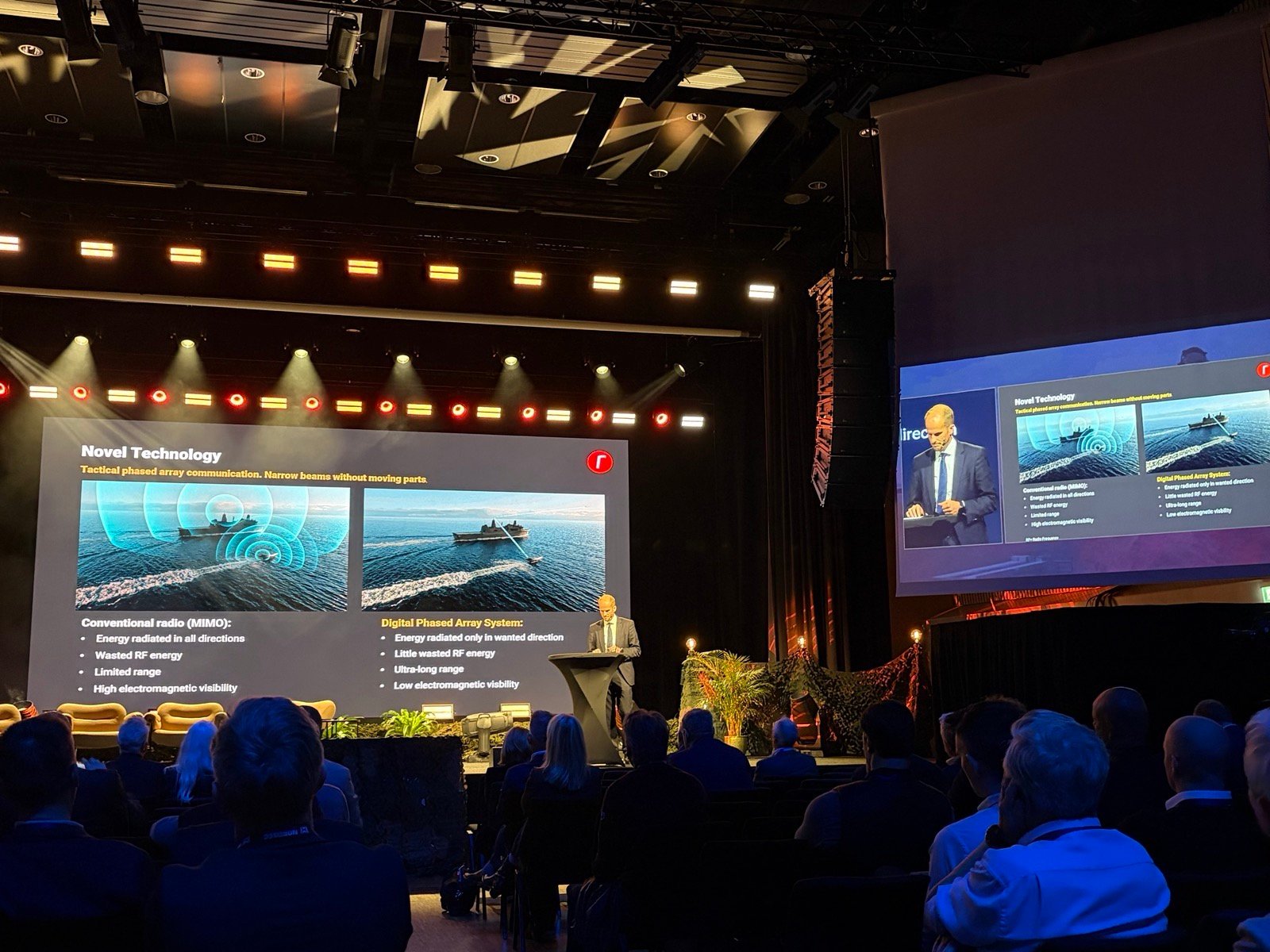 Photo: Håvard Katle Fjon/Radionor Communications AS
Building the defence companies of tomorrow
Closing the conference’s final industry presentation, Nypan left the audience with a broader reflection on the future of defence innovation.
Government agencies, military organisations and research institutions will still be present years from now, he argued. The real uncertainty concerns whether today’s innovative growth companies will still exist if procurement cycles remain lengthy and scaling remains difficult.
For Radionor, success came through persistence, calculated risk-taking and a willingness to invest long before the market caught up.
Its journey serves as a reminder that strengthening defence capability is not only about acquiring new equipment. It is also about creating an ecosystem where innovative companies can survive long enough to make a difference.